Welcome to the Finger Lakes! Our theme song:


In a town this size, there's no place to hide
Everywhere you go, you meet someone you know...
In a smokey bar, in the backseat of your car
In your own little house, someone's sure to find you out
What you do and what you think
What you eat and what you drink...

(Kieran Kane)

Showing posts with label Finger Lakes Food. Show all posts

Tuesday, September 4, 2012

Organic fad meets reality

White House organic garden

Organic foods: trendy, politically correct, more expensive, and no nutritional advantage.
Yet "there isn't much difference between organic and conventional foods, if you're an adult and making a decision based solely on your health," said Dena Bravata, senior author of the paper and a physician at Stanford's Center for Health Policy.
The data don't fit well with consumers' stated motivations for buying organic foods. A 2010 Nielsen study found that 76% bought them believing they are healthier, 53% because they allowed them to avoid pesticides and other toxins, 51% because they are more nutritious and 49% because organic farming is better for the environment.

Tuesday, June 5, 2012

Fighting food facism


A culture that redefines food choices as moral issues will demonize the people who don’t share the tastes of the priest class. A culture that elevates eating to some holistic act of ethical self-definition - localvore, low-carbon-impact food, fair trade, artisanal cheese - will find the casual carefree choices of the less-enlightened as an affront to their belief system. Leave it to Americans to invent a Puritan strain of Epicurianism.
We've had enough of the food fascists ourselves, and so has Professor Reynolds:
Let me be clear. These people are not well-meaning do-gooders who have just gone a bit too far. They don’t actually “mean well” at all. They don’t mean well, they mean to be in control. They are power-fetishists, drunk on the joys of bossing the little people around. They are not good people. They are evil. They should be ashamed of themselves, but shame — like taxes — is for the little people.
They don't like you.

Friday, May 18, 2012

Eating judgmentally

"Food you feel good about"
Finger Lakes residents, perhaps more than any other Americans, are constantly harassed by our elites:  "spend three times as much to buy organic food, or you're no better than Bush!"   While we're usually too polite to question our neighbors' religious beliefs, Diane Mapes has the cojones to ask the question:  "Does organic food turn people into jerks?"
Renate Raymond has encountered her fair share of organic food snobs, but a recent trip to a Seattle market left her feeling like she'd stumbled onto the set of "Portlandia."
"I stopped at a market to get a fruit platter for a movie night with friends but I couldn't find one so I asked the produce guy," says the 40-year-old arts administrator from Seattle. "And he was like, 'If you want fruit platters, go to Safeway. We're organic.' I finally bought a small cake and some strawberries and then at the check stand, the guy was like 'You didn't bring your own bag? I need to charge you if you didn't bring your own bag.' It was like a 'Portlandia skit.' They were so snotty and arrogant."
To see if Raymond is just a crank, or might be on to something, Mapes asked a scientist.
"There's a line of research showing that when people can pat themselves on the back for their moral behavior, they can become self-righteous," says author Kendall Eskine, assistant professor of  the department of psychological sciences at Loyola University in New Orleans. "I've noticed a lot of organic foods are marketed with moral terminology, like Honest Tea, and wondered if you exposed people to organic food, if it would make them pat themselves on the back for their moral and environmental choices. I wondered if  they would be more altruistic or not."
If you're not already singing harmony, and we suspect you are, read the whole thing.


h/t Museum Guy.

5/21 update -  Rush Limbaugh piles on: 
 Which Came First, the Jerk or the Diet?

Sunday, April 29, 2012

Where our food actually comes from


Family farm-raised Ronald Baily explains why he doesn't care where his food comes from:
One of the great glories of modern life is the enormous elaboration of the division of labor and how the efficiencies gained from that division makes people much wealthier than they could otherwise be. Since we all don't have to stitch our own clothes, bake our own bread, compound our own medicines, or even cook our own meals, we are all much better off.
Baily's 2002 post constitutes the official South of 5 and 20 position on  the "local foods" dogma so popular here in the Finger Lakes.

Tuesday, May 31, 2011

Organic produce kills 13

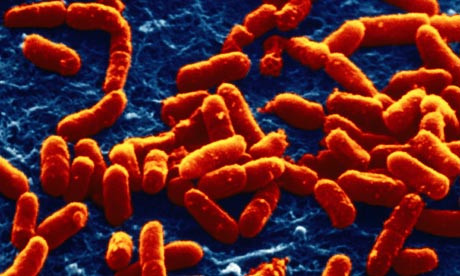
E. coli bacteria

The death toll from an E. coli bacteria outbreak in Germany has risen to at least 13, per this morning's New York Times.
The health authorities in Europe stepped up efforts on Monday to halt a deadly outbreak of a virulent form of E. coli bacteria in cucumbers as a dispute broke out between Spain and Germany over the source of the illness.
The federal and state authorities in Germany — where effects are by far most severe — said the death toll climbed to 13 by Monday, from 10 on Sunday, in one of the largest outbreaks its kind reported worldwide.
Not mentioned in the Times article is that the source of the deadly infection has been identified as organic produce from Spain.  If we read all the way through this CNN report, in the tenth paragraph we learn:
The European Food Safety Alert Network said EHEC, or enterohemorrhagic Escherichia coli, a strain of E. coli that causes hemorrhage in the intestines, was found in organic cucumbers originating from Spain, packaged in Germany, and distributed to countries including Austria, the Czech Republic, Denmark, Germany, Hungary, Luxembourg and Spain.
These seems to be a pattern of E. coli outbreaks originating with expensive, trendy "organic" produce.  If consumers chose to pay the price and take the risk with organics, we wish them the best of luck.  However, whether you like it or not, the FDA is using your tax dollars to subsidze the conversion of US agriculture to "organic practices."  For instance, we still have time to apply this $3,750,000 grant.
The overall goal of the Organic Transitions Program (ORG) is to support the development and implementation of research, extension and higher education programs to improve the competitiveness of organic livestock and crop producers, as well as those who are adopting organic practices. In FY 2011, ORG will focus on environmental services provided by organic farming systems that support soil conservation and contribute to climate change mitigation. Practices and systems to be addressed include those associated with organic crops, organic animal production (including dairy), and organic systems integrating plant and animal production.
Bold added.  Left to be understood is why taxpayers are being forced to subsidize the admittedly uncompetitive, risky, boutique organic industry.  Perhaps our esteemed readers can provide insight? 

Monday, January 24, 2011

Free to choose our own food

"Let's go cruise Wegman's, they're open all night"

Actual farmer Blake Hurst responds to backyard chicken dilettante Alexandra Ferguson:
Ferguson believes that “eating organically and locally contributes not only to the health of her family but to the existential happiness of farm animals and farmers.” I’m pretty sure that most of the farm animals around here spend little time worrying about Ferguson’s contributions to their existential happiness, and I’m darned sure that we farmers don’t.
 Hurst also reminds Ferguson to wipe her feet before she enters the house.

Wednesday, November 17, 2010

Modern is better

Whether it's food, shelter, or medicine, we've arrived at the current state of technology because it's proved better than whatever it replaced.  Millions of free people make individual decisions to maximize their own happiness.  Our servants in industry struggle to give us what we demand.  The results of this process of free choice gives us a selection of foods in our local supermarkets that is the envy of the rest of the world.

So, of course, our self-anointed elites tell us we're all wrong, and try to force us to allow them to make our choices for us.  They prefer we pay more for old-technology products, because the elites feel "they're better."  When it comes to beef, however, John Stossel points out Natural Isn't Always Better: 
Once again, modern technology saves money and is better for the earth. By stuffing the feedlot animals with corn, farmers get them to grow faster. Therefore they can slaughter them sooner, which is better for the earth than letting them live longer and do all the environmentally damaging things natural cows do while they are alive.
"Absolutely right," Capper said. "Every single day, they need feed, they need water, and they give off methane nitrous oxide -- very potent greenhouse gases that do damage."
But what about damage to people? Some advocates of grass-fed beef claim that the more naturally raised animals are healthier to eat.
"There is absolutely no scientific evidence based on that. Absolutely none," she replied. "There is some very slight difference in fatty acids, for example, but they are so minor that they don't make any significant human health impact."
But what about those hormones the cows are given? Surely that cannot be good for us.
"What we have to remember is every food we eat -- whether it's tofu, whether it's beef, whether it's apples -- they all contain hormones. There's nothing, apart from salts, that doesn't have some kind of hormone in them."

Saturday, November 6, 2010

Seafood tonight?

Fish Pier, Boston
Fresh seafood served in the Finger Lakes may have come ashore here.  If you're in the neighborhood, a good place to get some fresh air.  Just try to look like you work there.